Showing posts with label Places. Show all posts

Friday, October 19, 2012

Lahore, Town Hall and I

The Shahrahe Quaid-e-Azam, or the famous Mall Road of Lahore is studded with Victorian style buildings almost throughout its length. Starting from the Mian Mir Cantonment Bridge, the first one to appear is the Aitchison College on the right and then it continues till it ends near the building of the General Post Office Lahore.

The Town Hall, Lahore - 1890 [Photo courtesy Tahir Iqbal / Flickr ]
The major portion comes from the Lahore High Curt building, followed by the GPO, Tollington Market, Lahore Museum, the Punjab University, the National College of Arts and finally the Town Hall building. All buildings are unique in their Victorian architecture, specially the Town Hall building. It is this last building, that this post is about.

I saw this monumental building right from my younger age as the Double Decker buses of the Lahore Omnibus Service which I traveled on from my home to my school and later the Government College, turned right in front of the Town Hall building and this used to be the last glimpse of the Mall and buildings on it.

Lahore Town Hall
A beautiful painting by an unknown artist of Town Hall, Lahore in a pre-partition mood set displayed in Garrison Mess, Lahore ( I shot this with my cell phone camera while staying in the mess)

The building is presently under use by main government offices of the City District Government Lahore (CDGL) and Fire Brigade.

Town Hall building with two flags [Photo courtesy: Global Clock Time]

The importance of the Town Hall multiplied manifold after the 1965 Indo-Pak war. The Indian thrust of attack was two pronged aimed at the cities of Lahore and Sialkot. The people of the two cities fought side by side their brethren in uniform and supported the armed forces in every way they could. It was their support that enabled Pakistan Army from letting the Indian Army realize its aims and objectives and halted their forces far away from Lahore. 

Postage stamp showing the special Pakistan flag 'Hilal-e-Istaqlal' issued May 15, 1967
For the resilience shown by the people of Lahore and the support afforded to the armed forces, the government of Pakistan announced special flags, known as Hilal-e-Istaqlal, to the people of Lahore, Sialkot and Sargodha (Sargodha is a major Pakistan air force base from where successful air missions were flown both inside and outside Pakistan in support of the ground forces).

Citation for Lahore on the eve of award of Hilal-e-Istaqlal reads:
In the early hours of Monday, the 6th September, 1965, the enemy launched his treacherous attack without declaring war and advanced towards LAHORE from three directions. The enemy’s advance was stopped dead near the border on the very first day of the battle by our gallant Army, but he went on trying for a break-through until the end, which he could never achieve against the steel wall of our heroic forces. Throughout this period the enemy planes raided Lahore; and the outskirts of the city were subjected to shelling day and night. This bomb-ing and shelling of unarmed civil population brought death to many, including women and children. The enemy exercised intense savagery with complete lack of scruples. But the people of Lahore remained undaunted and unperturbed and faced the challenge with cool and un-waver-ing determination. People of all walks of life stuck to their jobs and went about their normal business without any signs of tension. They forgot all their incon-veniences and tried to help the country’s war effort to the best of their ability. Every day in their thousands they stood on the roads leading to the front. Every day hundreds of them headed towards the front line to join their gallant soldiers fighting the enemy and had to be restrained with great difficulty. The attitude of the people of Lahore during this period raised the already high morale of our troops to new heights and they answered their call by not only preventing the treacherous enemy from coming anywhere near their town but also by throwing him back and pursuing him into his own territory. Throughout this period the people of Lahore displayed their traditional cour-age and defeated the evil designs of the enemy to demoralize them. Their determination and devotion to the country will be re-called with pride by the generations to come. It will become an epic of our history that the enemy attacked “the heart of Pakistan”, for that is how Quaid-i-Azam described Lahore, but failed to hurt it; “the heart” throbbed on with health and vigor.


Hilal-e-Istaqlal [right] at Town Hall, Lahore
Now the Hilal-e-Istaqlal flies side by side the flag of Pakistan at the Town Hall building since the day it was first conferred upon the citizens of Lahore and is replaced every year on September 6, the day of the commencement of the war, now celebrated as the Defence Day each year.

Originally posted at Jaho Jalal

Wednesday, September 26, 2012

Lahore, Lakshmi Chowk and I

Originally posted at Jaho Jalal

Lahore has always been known as a warm, hospitable and entertaining city for centuries. Although, Lahore thrives and throbs in its every nook and corner, Lakshmi Chowk, situated on the cross roads of McLeod Road, Nisbat Road and Abbott Road, is one such place in Lahore which has not one but many facets that make it the heart of Lahore.
Lakshmi Chowk Map [Map: Google earth]
The place draws its name from the presence of the doubled storied Lakshmi Building [photo below], which is situated right on the cross roads as seen on the map above.


Lakshmi Building - watch its renovated look at the end of the post
I know Lakshmi Chowk very intimately, as for years I rode past the place in the double deckers of the Lahore Omnibus Service (LOS) during my school days. Since my house was located nearby on the McLeod Road, I also footed the place when going to watch a film as Abbott Road, an off shoot of McLeod Road from Lakshmi Chowk housed almost a dozen cinemas of Lahore.

Royal Park
In the early 20th century, when the films as entertaining media came to the then British India, Lahore became to be associated with the making of films as early as 1929 with the opening of the United Players' Studios on Ravi Road. And from then on, Lahore became an important film making centre with its many cinemas and film making studios, which were located in and around Lakshmi Chowk. Royal Park (pictured above and below) houses offices of major film distributors and producers of Lahore film industry.


Lakshmi Chowk has always been the focal point of Lahore’s film industry crowd. Even befoe the partition of British India in 1947, Lakshmi Chowk and Royal Park would throng with tongas and cars carrying film stars, film directors and producers in the evenings.

Indian superstars Pran, Muhammad Rafi, Om Parkash, Balraj Sani, Dev Anand and many less known artistes started their film careers from Lahore. Lakshmi Chowk was the hot spot for formal and informal film gatherings.All these actors later migrated to India in 1947.

Om Parkash who lived at Matti Chowk, Lohari Gate, always rented out a decorated tonga to Lakshmi Chowk every day. Pran lived in Qilla Gujjar Singh, half a kilometre away from Lakshmi Chowk. One day while standing at a pan shop in Lakshmi Chowk, he was picked up by Wali, a leading film director of the time, and offered him a role in his films. Wali wrote the address of Pancholi Studios (one of the most famous film studios of Lahore in Muslim Town) on the back of a cigarette pack, which brought Pran to the film industry.

There also was a hotel called King Circle at Lakshmi Chowk where film stars gathered. A bank has taken its place these days. 


I also have a long association with one once famous Aznic Studio, located just off the Lakshmi Chowk in the Royal Park on Abbott Road as seen in the photo above, which was our family photographer and many of our family portraits were shot by Aznic Studio.

Rattan Cinema located just off the Lakshmi Chowk was once a thriving cinema of the area. Initially named Balwanti Rai Theater in the pre-partition days as seen below, the cinema screened some of the best films of the time. However, the almost demise of Lollywood has forced the closure of the cinema and now it awaits some buyer to convert into a commercial centre or to be used as stage shows.
Balwanti Rai Theater (Rattan Cinema) - 1940 [Photo: Project Lahore]

As I said before, almost a dozen cinemas were once located in the vicinity of the Lakshmi Chowk, mainly on the Abbott Road. I saw these cinemas mushrooming from my childhood. Some of the pre-partition cinemas included Rattan, Odeon, Nishat and one more (I have forgotten the name). 


Odeon cinema screened some of the best English films of the time, but later it started screening local films before being turned into a hotel.

Gulistan Cinema
The place where Gulistan cinema stands today housed a dilapidated building with lot of wild growth around it. In fact turning left from the intersection of Abbott and Montgomery Roads, it was a Dracula's place before Gulistan cinema ushered in a line of new cinemas. We five brothers when passing through the place would walk a little faster en route to watch a movie at Plaza cinema, lest Dracula came out of the haunted building and grab one of us.

However, this once busy road with many cinemas like the Metroploe, Mehfil and Mubarak is losing its charm. Mehfil and Mubarak cinemas have since long bid farewell to movies and have become venues for cheap stage shows.

Pre Partition Ishwar Das building, now known as Newage building, located on McLeod Road just short of Lakshmi Chowk
Besides film makers' offices and the cinema houses, Lakshmi Chowk is a hub of traditional eateries of Lahore. In front of ex-Odeon cinema, there is a line of eateries offering skewered chicken, Harisa, Murgh Chanay and Tuka Tuk. Many are of the view that the term 'Tuka Tuk' originated from these eateries of Lakshmi Chowk. 

Baghdadi Haleem
However, the best thing to eat here is the Shahi Murgh Chanay (a heavily oiled and spiced curry of chick peas and chicken), which one can only enjoy if eaten fresh at the eatery with oven fresh bread. Whenever I go to Lahore, I try my best to visit the place at least once to eat Shahi Murgh Chanay. As for Baghdadi Haleem, pictured above, I wonder if the people of Baghdad ate Haleem - but this eatery surely attracts crowds interested in Haleem.
Beside traditional eateries, air conditioned restaurants like Lasani (above)and Tabaq(below) provide a pleasing sitting environment even in scorching heat of Lahore. Tabaq was the first eatery of Lahore that came up with the idea of broast chicken in special broast machines. From then on, the name Tabaq has become synonymous with broast chicken all over.
Dry fruits seller at Abbott Road
 Renovated Lakshmi Building as of today Photo: One Pakistan
Lakshmi Chowk houses old buildings dating pre-partion days and needed to be preserved in their original form. However, lately there has been an effort to 'renovate' and face uplift these buildings, as seen above, with gaudy colours and with complete disregard to the age of these building. The so called uplift seems completely out of place and the facade of buildings, specially that of the Lakshmi and Newage buildings has become an eye sour rather than the once elegance these buildings had.

There has also been attempts to demolish these buildings by their owners and erect new plazas. It was after strong public reaction that such attempts were blocked for buildings which have been placed under the conservation rules to preserve the historical heritage of Lahore.
Another landmark just off the Lakshmi Chowk on Nisbat Road is the famous Dyal Singh College (above) and Dyal Singh Library (below). The college and library were established as two separate trusts in 1898 according to Sardar Dyal Singh Majitha's will, who was a great humanitarian and lover of education and donated all his assets for the propagation of education.

Although, even today Lakshmi Chowk is a major centre of Lahore film industry, it is losing its glamour with the almost demise of the Lollywood. Now a few offices of film producers and distributors remain and it is seldom that actors and actresses visit the area to meet producers and directors. However, sometimes they are seen eating at some eatery around Lakshmi Chowk.

Photos Attribution: All photos above, except where explicitly attributed, are the property of Tahir Iqbal. Tahir is an avid photographer with keen eye to capture the street scenes and life of ordinary people. I have already shared his photos in a number of posts earlier posted at Jaho Jalal.

Related: 
Google Earth 
Posts composed of Tahir's Photos:

Saturday, July 21, 2012

Many Gates of Lahore and I

Lahore is a beautiful city to visit. It is a city of history or a history in city - take it both ways and it is true for Lahore. It figures out in all prominent and important historical documents and when talking of emperors, prince and princesses besides architecture and gardens. Lahore was most prominent during ad after the Mogul period and has thus is often termed as the showcase of Mogul architecture as each successive Mogul emperor had his share of adding beautiful buildings and gardens to add grandeur and beauty to Lahore.

While the marvels of Mogul architecture are spread all over Lahore, the Walled City of Lahore is one complex that encloses in itself the real Lahore which has thrived since time immemorial. One really doesn't know how old is the old Lahore enclosed in its once high walls with numerous entrances in all its sides. As per Wikipedia, and according to carbon dating evidence of archaeological findings in the Lahore Fort, the time period for in-habitation of Lahore could be anything as early as 2,000 BCE. 

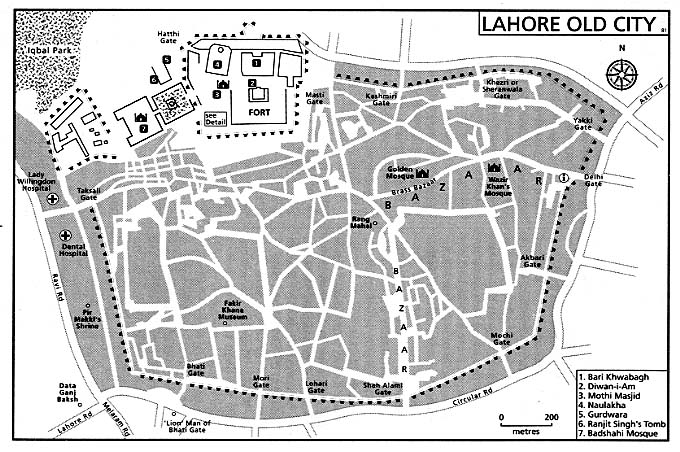
Map of  Walled City of Lahore [ Map: Wikipedia ]
The life in the walled city of Lahore truly reflects the actual and indigenous culture of Lahore. The walled city is dominated in the NNW by the massive Lahore Fort or the Shahi Qila (Royal Fort), while many beautiful structures, buildings and mosques, like the Wazir Khan Mosque and the Golden Mosque (Sunehri Masjid) inside the walls of old Lahore still stand majestically, though some in dilapidated condition now.

While it would take post after post to talk of life and architecture of the old city of Lahore, I will talk of the many gates that lead into the walled city.

In all there were thirteen gates around the walled city. All gates were built with typical arched style and were unique in their individual capacity. Each gate was given a particular name that described its facing, location and speciality in the overall context of Lahore. These thirteen gates were named as: Akbari Gate, Bhati Gate, Delhi Gate, Kashmiri Gate, Lohari Gate, Masti Gate, Mochi Gate, Mori Gate, Roshnai Gate, Shahalmi Gate, Shairanwala Gate, Taxali Gate, and Yakki Gate.

The gates guarded the walled city for as long they could sustain the onslaught of its invaders. However, these succumbed to the British Raj, when after occupation of Lahore by the British in the 19th century. While destroying many historical buildings like any ruthless warriors like the Chengiz Khan, nearly all gates were also demolished in order to 'de-fortify' Lahore. The only gate that survived the Britsh wrath was the Roshnai Gate, which is located between the Badshahi Mosque and the Lahore Fort.

Although, an effort was later made to rebuild these gates and restore these to their original shape, many were lost forever. Shahalmi Gate burnt to ground during the riots of 1947 while Akbari Gate was demolished for repairs but never built again. As of today, only six gates, namely Bhati Gate, Delhi Gate, Kashmiri Gate, Lohari Gate, Roshnai Gate, and Shairanwala Gate survive. Though recently a repair and renovation was undertaken, some gates are in pretty bad shape and require much attention and repair work.

Starting from the north clockwise, the first gate is the Masti Gate, just right of the Lahore Fort. No one knows why this gate was called so, but some historians contend that the name is a corruption of 'Masjadi Gate' referring to the mosque of the Mariyam Zamani Begum, mother of Emperor Jahangir, situated in its immediate vicinity. A little trace of this gate in its renovated form can still be seen.

Tonga coming out of the Kashmiri Gate
Next to Masti Gate is the Kashmiri Gate - Since the gate faces in the direction of Kashmir, the gate draws its name accordingly. Inside the gate, there is the famous Kashmiri Bazaar. There is also a girls college, which is housed in a big haveli which once belonged to a royalty and is a exotic piece of Mogul architecture.

The next gate almost in NNE direction is the Sheran Wala Gate. 'Sher' in Urdu language means lion. Thus the name means the gate of the lions. It is said that during the reign of Ranjit Singh he had kept here two domesticated lions and the gate came to be called Sheran Wala Gate.

Yakki Gate is the next gate in the NE direction. Like he Masti Gate, the name of this gate is also distorted. The original name was 'Zaki' - after the name of a saint who according to tradition died fighting against the Mughals, while gallantly defending the city. It is said that even after his head was cut off at the gate, his trunk continued fighting for sometime, and then fell close by. Head and the trunk of the saint was buried at their fallen places separately and both are revered to this day. No traces of this gate are found now.

Beautiful painting of Dehli Gate
Dehli Gate almost faces due east in the direction of now Indian city of Dehli. As part of the reconstruction of selected sites of Walled City, this gate has also been renovated. Many a historical places such as Shahi Hamam (Royal Bath), Chitta Darvaza (White Door), a number of old havalies and the famous Masjid Wazir Khan are situated inside this gate. The remains of the old gate still exist as “Chitta Darwaza” (the White Gate) about a hundred meters away from the present gate.


Rare picture of the Akbari Gate taken in 1962 [ Photo shared by Shiraz hassan at Lahore Nama ]

Akbari Gate comes next, named after the Emperor Akbar who rebuilt the town and the citadel. No traces of it exist today. How did it vanish, there is not much available. May be the gate due to neglect had collapsed and then no one took care of it, except clearing the rubble. However, the nearby famous market place "Akbari Mandi" takes its name from Emperor Akbar and is one of thriving main wholesale market of grains in Lahore, like the Jodia Bazaar of Karachi.

Mochi Gate was situated between Shah Aalmi and Akbari Gate. It is said that the gate is named in honour of Moti, a Hindu guard of the gate during the Mughal era. Later the name was distorted and became Mochi. But a more plausible explanation of the name is that Mochi in Urdu means a cobbler and it may have derived its name from cobblers that may have once thrived in the area. There is a prominent grave of a saint, which in olden times was in one of the cubical of the gate.At the entrance of the gate is a ground / garden called Mochi Bagh (garden), which during elections is a popular place for the political leaders to make speeches. The gate does not exist anymore.

Shah Aalmi Gate, located almost due south is named after Mohamad Moazam Shah Alam Bahader Shah, the son and successor of Aurangzaib. The gate was also said to be known as Bherwala Gate  once, but its popular name remains the Shah Almi gate. The gate does not exist now as it was burnt down in the partition riots of 1947. While the name still remains, it is synonymous to the famous Shah Almi market, which is a thriving business centre of Lahore.

Restored Lohari Gate
Lohari Gate draws its name from the word Lohar (Loha in Urdu means iron, thus Lohar means the blacksmith),  since there were many blacksmiths in the area in the olden days. Another explanation is that the gate takes its name from Lahore and was once called Lahori Gate, but has over a period of time distorted to Lohari Gate. Since the gate faces present Ichra, which was the actual Lahore in Hindu Raj, it is known as Lahori Gate. This gateway still exists in its renovated form and is famous for being one of the main entrances of the city. The out way from the famous Anarkali bazaar leads directly to this gate. 

I have visited the inside of Lohari Gate many times in my childhood as one of our relatives lived there in the famous 'Koocha Munjh Kuttan.'

Next to Lohari Gate is the Mori Gate. Although never a gate like the rest of the 12 gates, the so-called 13th gate, named as Mori Gate, was in old time a place used as outlet for the refuse and the sweepings of the city.

Bhaatti Gate as of now [ Photo: Tahir Iqbal / Flickr ]
Bhaati Gate is one of the most famous gates of the walled city. It is said that the real culture of old Lahore actually thrives inside the area of Bhaati Gate. "Bhatties" - one of the leading sub-caste of Rajputs once abounded the area of walled city, where this gate was constructed. Therefore the gate derived its name accordingly. This gate is situated at the south-western bend of the city in its renovated form. 

Still there are references that the word Bhatti is distorted name of Bhutti Gate. Riaz M Azlan, in his post "Chelsea of Lahore: Bhati Gate" at Lahore Nama writes:
In the books of history the account of this gate can be seen in the mid of 3rd century with reference to the Conqueror Raja Karpal Rao. Karpal built a castle with the name of “Bhatnair”. His offspring called Bhutti and Bhaati. In “Lahore ka Chelsea” (Chelsea of Lahore) Hakeem Ahmed Shuja writes; The real name of the gate is Bhutti gate, and it is the point where Bhutti Warriors of Multan camped before the arrival of Mughals and with time, “Bhutti “spoiled into “Bhaati”.
Tahir Iqbal underneath his above photo of Bhatti Gate adds:
Bhaatti Gate is one of the two oldest entry points into the Walled City which controlled the only major north-south thoroughfare during Ghaznavid period. When the Emperor Akbar expanded the city eastward and divided it into nine districts or Guzars, Bhati Gate and its bazaar marked the boundary between Guzar Mubarak Khan (east) and Guzar Talwarra (west). It was called Bhati Gate because it opens in the direction of Sandal Bar named after Rai Sandal Khan a Bhatti Rajput who lived there in ancient times.
The famous poet and philosopher Dr Allama Mohammad Iqbal used to live inside Bhaati Gate when he was doing his graduation from the famous Government College. 

For some unknown reasons, whenever referring to the Lahorites, mention of this gate is the first one that comes to the mind. People of Bhatti gate are lively and they love to eat heavy and good food mainly Sri pai, halva puri and lasi. The favorite sport among the people here is wrestling. Famous wrestler Kala Maro also belongs to Bhatti gate. 

Just outside of Bhati Gate is Data Durbar, the mausoleum of the Sufi saint Ali Hajweri (also known as Data Sahib Ganjbaksh). Every Thursday evening musicians used to gather here to perform Qawwali music, but these days qawalies have been replaced with Naats and religious sermons.

There is so much to write about Bhatti Gate, that it requires another full post about it, which I shall in time, God willing.

The Taxali Gate, located opposite the famous Lady Wellington's Hospital, takes its name from "Taxal" or Mint once located nearby during the Mogul period. It once provided access through the wall that extended the western length of the city. It was heavily fortified and was designed to protect the city from any attack from the west-ward." With the passage of time this gate has completely vanished. 

There is a very famous shoe market located here known as Sheikupurian Bazar. There are a variety of foods available in and around this gate - one of the most beloved being Sri Pai from Fazal Din aka "Phajja." 

Roshnai Gate [ Photo: SaffyH / Flickr ]
And the last and most well kept and untouched by the British during their defortifying campaign is the Roshnai Gate (photographed above), situated at the northern extreme of the city, adjacent to the Lahore Fort. Since it was generally lit at night, it got its name from the Urdu word "Raushni" (the light). Being the principal entrance form fort to city, it was most frequented by the high gentry, courtiers and royal servants. Being part of the Fort-Mosque complex, it has been renovated with lot of care and stands out from all the rest of the gates.

From Masti Gate to Roshnai Gate, the loop of walled city of Lahore completes. While I have been to the areas inside the Bhaati and Lohari Gates, I intend going from the other entrance to the inside of Lahore City someday and write about the grandeur of the once thriving city of Lahore which now consists of mostly dangerously dilapidated old building built astride narrow alleys.

Restored White Gate / Dehli Gate
I may add here that ehe Government of Pakistan and the World Bank in 1983 prepared a cultural heritage conservation plan through the World Bank's Lahore Urban Development Project, which focused on the repair and restoration of the Delhi Gate (a principal entrance to the Walled City), the Delhi Gate Bazaar and the Shaahi Hammam (Royal Baths), located just inside the Delhi Gate.

References:
Walled City of Lahore (Pakistanpaedia)
Walled City of Lahore (Wikipedia)


Originally posted at Jaho Jalal